Tuesday, June 23, 2009


Tuesday, September 9, 2008
Dos Lunas reposado tequila
Today a discussion about Dos Lunas Reposado tequila. The is a newcomer to the premimum tequila market. Accoding to the company the tequila is produced by Tequilas del Senor in Guadalajara, Jalisco, Mexico under direction from Dos Lunas. Dos Lunas is headquartered in El Paso, Texas.
The reposado is aged for nine months in new American oak barrels and used bourbon barrels.
Our initial tasting neat was a bit hot, but a smooth finish. Hints of cocoa aroma and coconut surprised us. There is a wonderful organic flavor that is very difficult to place. Somewhere between wet sandy minerals and fruit. We added a few pieces of chipped ice and the flavors became more clear and wonderful.
Our favorite way of serving this fine tequila is over ice with a splash of soda water. It treates you with a very clean, slightly bubbly, organic and flavorful agave.
The reposado scored 94 points at the 2006 International Review of Spirits in Chicago, a year before full production came on line. We can see why. This is our favorite reposado to date. In fact we can't wait to get our grubby mits on the next bottle. The only flaw is the strange top used on the bottle. The cork that rests under the copper colored cap feels like it will snap off at any time. But hey, if the cork is the only thing we have to critique, its all good for Dos Lunas.
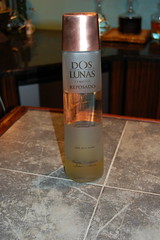
The reposado is aged for nine months in new American oak barrels and used bourbon barrels.
Our initial tasting neat was a bit hot, but a smooth finish. Hints of cocoa aroma and coconut surprised us. There is a wonderful organic flavor that is very difficult to place. Somewhere between wet sandy minerals and fruit. We added a few pieces of chipped ice and the flavors became more clear and wonderful.
Our favorite way of serving this fine tequila is over ice with a splash of soda water. It treates you with a very clean, slightly bubbly, organic and flavorful agave.
The reposado scored 94 points at the 2006 International Review of Spirits in Chicago, a year before full production came on line. We can see why. This is our favorite reposado to date. In fact we can't wait to get our grubby mits on the next bottle. The only flaw is the strange top used on the bottle. The cork that rests under the copper colored cap feels like it will snap off at any time. But hey, if the cork is the only thing we have to critique, its all good for Dos Lunas.
Thursday, August 28, 2008
Bison Grass Vodka
This is a Polish vodka called Zubrowka and is a dry herb flavored vodka distilled from rye. The spirit is mixed with a small addition of Hierochloe odorata, also known as Bison Grass. The grass grows in portions of Poland and Blearus. Each bottle has a decorative blade of bison grass in the bottle, but it does not add anything to the drink.
Bison grass contains a toxic compound coumarin which is prohibited by the FDA and thus caused the drink to be banned in 1978 to the US. By nurtalizing the comound and making Bison Grass Vodka coumarin- free, the US is now able to bring the flavor of Bison grass vodka back.
We found this bottle in Cleveland, OH. I have not seen it anywhere else yet. We drank it neat and on ice. I was surprised by the flavors. Vanilla and fresh cut grass was the dominate flavor. Coconut and almond came through in the finish. I am not a lover of flavored sprits, but this is so unique that it should be tried if you can find it. I assume the green color is an artificial coloring agent.
Some believe bison grass contains an aphrodesiac....perhaps...give it a try and tell me what you think.
Traditionally, the bison grass vodka is mixed with apple juice, a drink known in Poland as Tatanka and in Britian as a Frisky Bison.

Bison grass contains a toxic compound coumarin which is prohibited by the FDA and thus caused the drink to be banned in 1978 to the US. By nurtalizing the comound and making Bison Grass Vodka coumarin- free, the US is now able to bring the flavor of Bison grass vodka back.
We found this bottle in Cleveland, OH. I have not seen it anywhere else yet. We drank it neat and on ice. I was surprised by the flavors. Vanilla and fresh cut grass was the dominate flavor. Coconut and almond came through in the finish. I am not a lover of flavored sprits, but this is so unique that it should be tried if you can find it. I assume the green color is an artificial coloring agent.
Some believe bison grass contains an aphrodesiac....perhaps...give it a try and tell me what you think.
Traditionally, the bison grass vodka is mixed with apple juice, a drink known in Poland as Tatanka and in Britian as a Frisky Bison.
Monday, June 2, 2008
Tres Generaciones by Sauza
Up this week is a Reposado tequila by Sauza called Tres Generaciones. What a delight this was. $32 USD and well worth every penny. Very smooth, slight oak flavor with hints of pear and vanilla. Wonderful finish that gives a warm fuzzy feeling. Normally I run from big name barands with huge marketing budgets but this one is good. 100% Agave and a beautiful clear amber color. Two big thumbs up.

Monday, May 5, 2008
Tails of the Merman: The Exciting Conclusion
Well, E33's project is finally over, such fun to partake in. A sequel? Wait and see.
Monday, April 28, 2008
Ti-Toki Liqueur
Lets talk exotic liqueurs. Ti-toki liqueur from New Zealand is made from Titoki berries, kawakawa and manuka leaves. It is a sweet liqueur reminding me of Licor 43 or Nassau Royal. It has hints of vanilla, but after that the tastes become exotic. Hard to describe but it is mellow and almost flat at first. The tastes open up as you continue to sip it. After a few sips the flavors become more complex, but still undescribable, especially to those of us, not used to New Zealand herbs, and flavors. The flavor of manuka is clear in this liqueur. Manuka is a native shrub or small tree to New Zealand and southeast Australia. Manuka is a Maori word, but the Australians call it tea tree, probably from Captain Cook who used the leaves to make a tea drink in his early explorations of New Zealand. Manuka contain high antibacterial potency and the plants have been used by the Maoris as a natural medicine.
The Ti-toki liqueur company produces the product in a hand crafted tekoteko crock. A tekoteko is a Maori term for a full figured human form. They are usually found attached to a gable of the whare (house), or freestanding close to the whare. They are usually carved with the tongue outstreched and contain paua shell inlayed eyes to ward off intruders. The crock is available in a 500ml capacity or can be purchased in a glass bottle for less money. The crock comes with a cork that must be opened with a wine screw, but they give you a cork cap after the original has been removed. The bottle cost about $60 USD. Thankfully this one was a gift.
It tastes great straight, but if you add one part Ti-toki to 3 parts ginger beer it is a home run.
Exotic, fun and you get a cool Maori tekoteko to watch over your bar to keep away evil spirits (Barcardi).
Kia Ora.
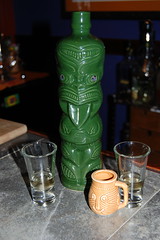
The Ti-toki liqueur company produces the product in a hand crafted tekoteko crock. A tekoteko is a Maori term for a full figured human form. They are usually found attached to a gable of the whare (house), or freestanding close to the whare. They are usually carved with the tongue outstreched and contain paua shell inlayed eyes to ward off intruders. The crock is available in a 500ml capacity or can be purchased in a glass bottle for less money. The crock comes with a cork that must be opened with a wine screw, but they give you a cork cap after the original has been removed. The bottle cost about $60 USD. Thankfully this one was a gift.
It tastes great straight, but if you add one part Ti-toki to 3 parts ginger beer it is a home run.
Exotic, fun and you get a cool Maori tekoteko to watch over your bar to keep away evil spirits (Barcardi).
Kia Ora.
Thursday, April 24, 2008
El Tesoro Platinum tequila
A few weeks ago I ran out of tequila and found myself in my happy place...the liquor store. I have been enjoying good tequila lately and have been trying out different brands. Patron Silver has been popular in the house, but I know there are better deals out there. The selection of tequila is large. First you need to decide what tatste you are looking for.
Blanco or white, silvers or platinums have a more mellow, less classic tequila flavor. They are un-aged and immediately stored after distillation or aged less than two months in oak barrels.
Oro of Gold is un aged blanco blended with rested or aged tequilas and often use caramel coloring or sugar based syrup or oak extract for added color to resemble an more aged tequila.
Reposado is aged a minimum of two months but less than a year in oak barrels giving is a golden color with hints of oak flavor.
Anejo is aged a miniumum of one year, but less than 3 in oak barrels.
Extra Anejo is aged a minimum of three years in oak barrels.
I prefer to drink a nicer tequila shaken with ice and served in a large shot glass. Cold is nice and the small added water from the ice melt helps bring out the flavors. Some prefer to bite into a lime wedge after drinking the tequila, but when tasting I will omit the lime to keep the flavors pure.
This round I tried the El Tesoro Platinum. They have been making fine tequila for 71 years. Don Felipe built La Altena in the mountains of Jalisco, Mexico in 1937 and his family continues to produce award winning tequila the old way.
I was very impressed with this tequila. Exceptionally smooth, with no mouth burn. The swallow is wonderful and the flavors are sublte and crisp. The price point of $28 USD makes this a true winner. Cheap enough to mix with, but equally wonderful to sip. Look out Patron silver, this one has you beat.
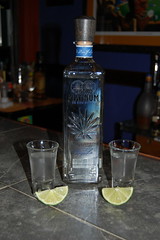
Blanco or white, silvers or platinums have a more mellow, less classic tequila flavor. They are un-aged and immediately stored after distillation or aged less than two months in oak barrels.
Oro of Gold is un aged blanco blended with rested or aged tequilas and often use caramel coloring or sugar based syrup or oak extract for added color to resemble an more aged tequila.
Reposado is aged a minimum of two months but less than a year in oak barrels giving is a golden color with hints of oak flavor.
Anejo is aged a miniumum of one year, but less than 3 in oak barrels.
Extra Anejo is aged a minimum of three years in oak barrels.
I prefer to drink a nicer tequila shaken with ice and served in a large shot glass. Cold is nice and the small added water from the ice melt helps bring out the flavors. Some prefer to bite into a lime wedge after drinking the tequila, but when tasting I will omit the lime to keep the flavors pure.
This round I tried the El Tesoro Platinum. They have been making fine tequila for 71 years. Don Felipe built La Altena in the mountains of Jalisco, Mexico in 1937 and his family continues to produce award winning tequila the old way.
I was very impressed with this tequila. Exceptionally smooth, with no mouth burn. The swallow is wonderful and the flavors are sublte and crisp. The price point of $28 USD makes this a true winner. Cheap enough to mix with, but equally wonderful to sip. Look out Patron silver, this one has you beat.
Monday, April 21, 2008
Lemon Hart and El Dorado showdown
Today we have a little head to head throwdown comparing my favorite type of rum, Demerara. Demerara rum is made in Guyana on the northern portion of South America. The country has three major rivers with the Demerara being the centrally located one. It ends in Georgetown and spills into the Atlantic. The flood plain region surrounding the river creates an oasis for growing demerara sugar cane, the same sugar used in making Demerara rum. The rum has a strong molassas flavor and a beautiful dark brown color. Demerara rum is an essential ingrediant in many tiki drinks and if you can find it, must be a staple in your home bar.
A good friend brought me a bottle of Lemon Hart which is like gold in my neck of the woods. It is a very difficult rum to find and when he showed up with it, I had to compare it to the El Dorado brand that is available to me.
El Dorado makes a 5, 12, 15 and 21 year old. The 15 is of such high quality that it is rarely used for mixing drinks. Straight up or on the rocks is the best method for serving it. Mellow and smooth the taste is wonderful. I use the 5 year old for most of my drinks calling for Demerara. It's cheap, very tasty and adds the necessary molassas flavor to the drinks. There is no alternative when Demerara is called for. El Dorado is a young distiller, founded in 1992, but they use the locally grown demerara sugar and have done a wonderful job at producing a high quality rum.
Lemon Hart was founded in 1804. It has a long history of distilling, but it has become very diffucult to find, especially in the Southern US states. I was so anxious to pit these two head to head and find out if the Lemon Hart lived up to its reputation. Like El Dorado, Lemon Hart also sells gold, white, 5, 12, 15, and 21 year old rum, all made with locally grown demerara sugar. This battle is between the 5 year old El Dorado and the regular Lemon Hart. There is no age on it, but it is probably a mix of young and old making comparable to the 5 year old El Dorado.
The color test. Both are deep brown as expected with any Demerara rum. The Lemon Hart is deeper in color. Both have great long lasting legs around the glass and both are very similar in aroma. The Molassas shines in the aroma. At first taste the Lemon Hart is more complex in it's flavors. It is similar to the El Dorado, but there is just more there. Both benefit from a few chips of ice. This brings the flavors to life. The Lemon Hart takes first place, but not by much. Perhaps because I'm used to the El Dorado and the Lemon Hart is slightly more complex. I will make a Mai Tai with both later to see how they mix. Both are great, and I'm glad to have finally had the chance to give the Lemon Hart a go. Bottom line. You need Demerara in your bar, no matter what brand you can find.
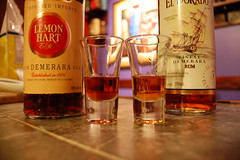
A good friend brought me a bottle of Lemon Hart which is like gold in my neck of the woods. It is a very difficult rum to find and when he showed up with it, I had to compare it to the El Dorado brand that is available to me.
El Dorado makes a 5, 12, 15 and 21 year old. The 15 is of such high quality that it is rarely used for mixing drinks. Straight up or on the rocks is the best method for serving it. Mellow and smooth the taste is wonderful. I use the 5 year old for most of my drinks calling for Demerara. It's cheap, very tasty and adds the necessary molassas flavor to the drinks. There is no alternative when Demerara is called for. El Dorado is a young distiller, founded in 1992, but they use the locally grown demerara sugar and have done a wonderful job at producing a high quality rum.
Lemon Hart was founded in 1804. It has a long history of distilling, but it has become very diffucult to find, especially in the Southern US states. I was so anxious to pit these two head to head and find out if the Lemon Hart lived up to its reputation. Like El Dorado, Lemon Hart also sells gold, white, 5, 12, 15, and 21 year old rum, all made with locally grown demerara sugar. This battle is between the 5 year old El Dorado and the regular Lemon Hart. There is no age on it, but it is probably a mix of young and old making comparable to the 5 year old El Dorado.
The color test. Both are deep brown as expected with any Demerara rum. The Lemon Hart is deeper in color. Both have great long lasting legs around the glass and both are very similar in aroma. The Molassas shines in the aroma. At first taste the Lemon Hart is more complex in it's flavors. It is similar to the El Dorado, but there is just more there. Both benefit from a few chips of ice. This brings the flavors to life. The Lemon Hart takes first place, but not by much. Perhaps because I'm used to the El Dorado and the Lemon Hart is slightly more complex. I will make a Mai Tai with both later to see how they mix. Both are great, and I'm glad to have finally had the chance to give the Lemon Hart a go. Bottom line. You need Demerara in your bar, no matter what brand you can find.
Tuesday, March 18, 2008
Start of the 2008 12 Hours of Sebring on turn 1
Alright racing fans, the start of the ALMS season is now underway. The 56th running of the 12 Hours of Sebring is in the history books. Congratulations go to Porsche and Penske Racing for an outstanding overall victory. Porsche won it's first overall victory in 20 years and its great to see them back on top of the game.Lots of photos of the race can be found on my flickr site.
www.flickr.com/photos/9935150@N08/sets/72157604141048751/

www.flickr.com/photos/9935150@N08/sets/72157604141048751/
Friday, March 7, 2008
Audi R8 at Sebring 2002
This is the Champion Racing Audi R8 taken from the pit box during a night practice. This car finished 2nd overall 1 lap behind the winning Audi R8. It was driven by Andy Wallace, Stefan Johansson and Jan Lammers. It started 5th with a qualifying time of 1:50.797. The reflective graphics really pic up the flash nicely. No photoshop here folks.

Subscribe to:
Posts (Atom)
